Oshi Casino AUD Deposits, Cards & Crypto Banking AU
Updated November 2026
Licensed
 Available in AU
Fast payouts
18+ Only
Funding and cashier guide
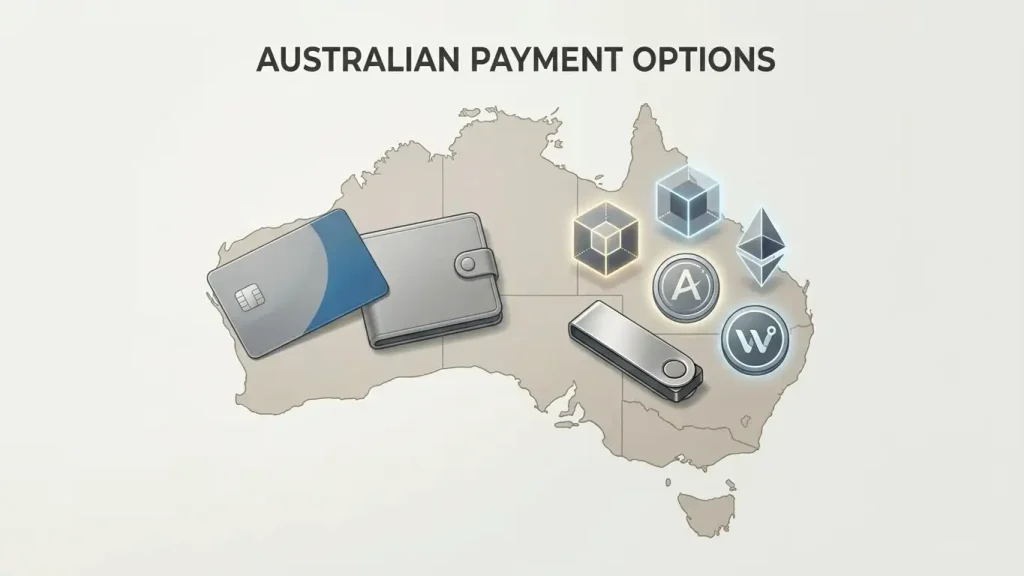
Oshi supports Australian dollars and a broad payment mix that includes cards, bank-transfer options, e-wallets and multiple cryptocurrencies. Crypto options include Bitcoin, Ethereum, Litecoin and Tether. The important limitation is that a global payment list does not prove that every named method is available to every Australian account, so PayID, Osko, POLi or BPAY should only be treated as available when they appear in the live Oshi cashier for the account.
For Australians, Oshi’s mix is unusual mainly because crypto plays a much larger role than it does in everyday local payments. Reserve Bank of Australia research shows cards remain the dominant consumer payment method, PayID is mainstream, and crypto is still niche for ordinary payments. That makes the practical choice at Oshi less about finding the longest method list and more about deciding whether familiar card-style funding or a crypto wallet better fits how you already manage money.
Table of Contents
- Oshi Casino Payment Categories: AUD, Cards, E-Wallets & Crypto
- AUD support: useful, but not the same as local payment integration
- How Oshi's cashier compares with Australian payment habits
- Cards versus crypto: the practical trade-offs
- Deposit support and withdrawal support are different questions
- Where the welcome bonus fits into payment choice
- Payment method checklist for an Australian account
- Australian payment rails require an account-level check
- Regulatory context does not change the payment facts
- A mixed cashier with unusually prominent crypto support
Oshi Casino Payment Categories: AUD, Cards, E-Wallets & Crypto
Oshi supports four broad payment categories: cards, bank transfers, e-wallets and cryptocurrencies. AUD is also supported as a player currency. Together, those points establish that the cashier is not crypto-only and not card-only.| Category | Oshi support | What an Australian user should check |
|---|---|---|
| Cards | Supported as a payment category. | Whether the specific card type and issuing bank are accepted for your account. |
| Bank transfer | Supported as a broader category. | Whether a transfer option is offered in the Australian cashier and whether it is available for deposits, withdrawals or both. |
| E-wallets | Supported as a broader category. | Which wallet brands appear after login and whether they support cash-out as well as deposits. |
| Cryptocurrency | Multiple coins are supported, including Bitcoin, Ethereum, Litecoin and Tether. | Network, wallet address, minimums shown in the cashier and whether you want account records split between AUD and digital assets. |
AUD support: useful, but not the same as local payment integration
AUD is a supported player currency at Oshi. For an Australian reader, that is useful because balances can be displayed in a familiar denomination and casino amounts do not have to be mentally converted from euros or US dollars just to understand the account. However, AUD support should not be overread. It does not prove that Oshi is connected to every Australian domestic payment rail, and it does not imply Australian licensing. Currency support answers one narrow product question: can the account use Australian dollars? Local payment integration and regulatory status are separate questions. This distinction is especially important with PayID. Reserve Bank of Australia data shows PayID is widely used locally, but PayID should not be assumed to be an Oshi method merely because Australian consumers commonly use it elsewhere. Confirm it only if it appears in the live Oshi cashier for the account. In practice, treat account currency and payment-rail availability as separate checks. AUD support tells you how the casino can denominate the account, while the cashier tells you which deposit and withdrawal routes are actually available to that account at that moment.How Oshi’s cashier compares with Australian payment habits
The Reserve Bank of Australia’s 2025 Consumer Payments Survey, published in 2026, found that cards remained the predominant consumer payment method in Australia, with debit cards accounting for around half of payments. The same research found that roughly half of respondents had used PayID in the prior year. Crypto, by contrast, had high awareness but low use for general consumer payments, with around 2% of respondents reporting a crypto payment in the prior year. That context changes how Oshi’s payment menu should be read. A card option maps closely to mainstream Australian behaviour. A crypto option does not. At Oshi, crypto is a prominent funding category even though it remains marginal in ordinary Australian retail payments. This does not make one route inherently better. It simply means the two routes have different friction. Cards are familiar, widely understood and easier for many people to reconcile with ordinary bank statements. Crypto can suit users who already hold digital assets and understand wallet transfers, but it introduces network handling, address accuracy and asset-price considerations that are irrelevant to a conventional card deposit. The RBA market context can be checked directly in its Consumer Payment Behaviour in Australia bulletin.Cards versus crypto: the practical trade-offs
Using a card
A card is the more familiar route for most Australian consumers. It keeps funding connected to an existing bank relationship and avoids the extra step of acquiring cryptocurrency before making a deposit. For record-keeping, it also keeps the transaction closer to ordinary personal-finance workflows. The downside is that a card being supported by the casino does not guarantee that every issuer will authorise every transaction. Bank controls, merchant classifications and account-level restrictions can affect whether a payment goes through. If a card is declined, do not assume the correct response is to keep retrying or to find a way around a bank control. Check the reason with the issuer and decide whether you want to continue.Using cryptocurrency
Oshi supports multiple cryptocurrencies, including Bitcoin, Ethereum, Litecoin and Tether. This gives existing crypto users a direct digital-asset route, but it also means the user is responsible for selecting the correct asset and destination details shown by the cashier. Crypto transfers are not simply “faster cards.” They are operationally different. Wallet addresses must be copied accurately, networks must match the receiving instructions, and transactions can be difficult or impossible to reverse if sent incorrectly. Stablecoins such as Tether reduce one kind of price volatility compared with assets such as Bitcoin or Ethereum, but they still involve wallet and network handling. Most importantly, crypto should not be treated as a tool for bypassing local controls, bank decisions or legal restrictions. The useful comparison is convenience for someone who already understands the method, not circumvention.Deposit support and withdrawal support are different questions
A common mistake is to see a payment method on a deposit screen and assume the same method will be available for cash-out. Casinos can separate deposit and withdrawal rails, and account verification can affect which withdrawal options are shown. Before depositing, look beyond the first transaction. Ask how you expect to withdraw later. If you fund by a method that cannot receive withdrawals, the casino may require a different verified method for cash-out. That can add steps even when the original deposit is simple. Exact withdrawal-processing times, fees and periodic limits can vary by method and account. The dedicated cash-out methods covers cash-out mechanics separately, including where to confirm live limits and account-specific conditions.Where the welcome bonus fits into payment choice
A payment method can be available in the cashier but still have different promotion eligibility. If you intend to use the welcome offer, check the promotion before depositing rather than assuming every method qualifies. The welcome structure uses a deposit match with free spins, but qualifying-deposit rules and other conditions can vary with the live offer. Check the promotion attached to the account before choosing a payment method specifically to claim a bonus. The welcome bonus explains how to assess wagering, game contribution, expiry, maximum-bet rules and withdrawal interaction without treating the headline amount as the whole value proposition.Payment method checklist for an Australian account
- Choose the account currency first. If you want an AUD-denominated balance, confirm AUD is selected before funding.
- Use only a method offered inside your current cashier. A method mentioned on an old review is not enough evidence that it is available to your account today.
- Check ownership requirements. Use payment instruments in your own name and keep account details consistent with registration information.
- Think about withdrawal before deposit. Confirm whether the same method can receive funds back or whether another verified withdrawal route may be needed.
- Separate bonus eligibility from payment availability. A working deposit method is not automatically a qualifying bonus method.
- For crypto, verify asset and network carefully. Do not rely on memory from a previous transfer; follow the current cashier instructions.
- Do not infer local payment support. PayID, Osko, POLi and BPAY should only be treated as Oshi methods if they are visibly offered in the live cashier for the account.